


Prof. Dr. Jan Oliver Schwarz
,
Nicolas Inzelmann
,
October 15, 2026


AI can generate scenarios and trend material faster than ever. Jan Oliver Schwarz argues that the real value of foresight still depends on participation, perspective and the quality of the decisions that follow.
Infinitas Security x BavarianForesight-Institut at Technische Hochschule Ingolstadt
Generative AI has changed the speed of foresight work. Tasks that once took teams weeks or months can now be supported in minutes: gathering material, structuring trends, generating scenario drafts and creating visuals. For Jan Oliver Schwarz, however, speed is not the main question. The more important question is whether an organization can actually act on what it produces.
With more than 20 years of experience in strategic foresight, Jan has worked extensively on how organizations deal with uncertainty and turn possible futures into strategic decisions. That perspective is especially relevant when looking at how AI, scenarios and strategic simulations can support cybersecurity decision-making.
That distinction matters especially in cybersecurity, where teams already work with risk assessments, management reports and increasingly AI-supported analysis. A polished risk report, a set of scenarios or an AI-generated recommendation can create the appearance of clarity. But if the people who need to make decisions have not built a shared understanding of the assumptions, dependencies and trade-offs behind it, the output may have little effect on what the organization does next.
The focus here is therefore not only on the tools themselves, but on how they are used. AI, strategic conversations, scenario work and simulations all have a role. The central thread is participation: future thinking becomes useful when people do more than receive an answer. They engage with the uncertainty themselves.
Jan starts with a tension he sees in the foresight community. It is now possible to generate scenarios on almost any topic within minutes. That is a dramatic change from projects that could previously take months. But a faster scenario report does not automatically create a more future-ready organization.
“The fundamental question is not how fast I can develop scenario reports, but how we enable organizations to act on that information.”
His concern is familiar from many corporate processes. Reports are created, presented and then left on physical or virtual desks. Even when they are read, there is another question: were they understood in a way that changes how people think and act?
Scenario work becomes especially vulnerable to this problem because its purpose is not to identify one future. If a leadership team receives four plausible scenarios and immediately asks which one is going to happen, the underlying logic has not landed. The organization has received content without developing the capacity to use it.
AI can make that gap wider if it is treated primarily as a report generator. The organization may get more material, faster, while doing less of the thinking that makes the material useful.
This is not only a foresight problem. The same pattern appears in IT and cybersecurity teams when risk reports, assessments or recommendations are produced, but the people who need to act on them are not part of the reasoning behind them. The value is not only in the output itself, but in building a shared understanding of why a risk matters, how it connects to the business and what decisions follow from it.
Jan repeatedly comes back to what he calls strategic conversation. The value of a foresight process is not concentrated in the final document. It is created when people are involved early enough to challenge assumptions, discuss different perspectives and become comfortable working with several futures at once.
He describes one project with a Swiss defense procurement organization that initially asked for a technology trend report. The team could provide the report, but they were concerned that even a rigorous document would not create the necessary shift in thinking on its own. They therefore added a workshop format that could be run in about 90 minutes. Participants worked with the trends and explored what they could mean for the future.
For Jan, the difference was the engagement. People were not only reading conclusions. They were working through the material together.
“Being engaged in the process really shifts people’s minds. They can then start reading and acting on the scenarios.”
This is an important principle for security work as well, not only when going through a foresight process, but also when building a shared understanding of the organization’s current security state. Assessments, findings and management reports can document that picture, but they do not create the understanding behind it.
For security teams, this means that identifying risks or documenting control gaps is only part of the work. The real value emerges when those findings become part of a shared discussion about business dependencies, priorities and the decisions that follow.
That deeper understanding develops when business, security and other relevant stakeholders engage with the assumptions, dependencies and trade-offs behind the findings. Where do different teams see the situation differently? Which dependencies matter most? What changes the risk picture?
A report can capture the outcome of that work. It cannot replace the conversation that created it.
Jan sees substantial value in AI. He highlights its ability to accelerate trend research and help structure large amounts of material. It can also support scenario visualization and bring another perspective into a workshop. He describes experiments in which AI is treated almost like another participant at the table, with useful capabilities but also clear limitations.
At the same time, he warns that AI works with the information available to it, and that information carries its own biases. Foresight is particularly sensitive to that limitation because there is no solid dataset of the future waiting to be analyzed. The inputs are observations, narratives, assumptions and signals from the present.
This is why faster synthesis does not remove the need for judgment. It makes the division of labor more important.
“Where do I need the human in the room? And where do I have efficiencies through AI?”
Jan also sees clear improvements in what teams can produce. In student projects, for example, the ability to visualize scenarios has changed dramatically in a short period. But the results still reveal differences in skill. Some outputs become generic, repetitive or poorly matched to the scenario. The tool can expand what is possible without eliminating the need to know what good use looks like.
The practical question is therefore not whether AI belongs in foresight. It is where it improves the process and where it begins to replace the thinking that the process was meant to create.
In cybersecurity, that distinction is particularly relevant when AI helps teams analyze risks or prepare strategic decisions. Faster analysis can reduce effort, but it should not remove the discussion about what a finding means for the organization, which assumptions it depends on and what level of risk the business is actually willing to accept.
One experiment Jan describes makes that risk concrete. In a scenario planning exercise, one group was allowed to use whatever AI tools they could access while another group worked without them. The difference was visible not only in the outputs, but in the way the groups spent their attention.
The group without AI was more engaged in questions such as which trends were relevant, where weak signals might be developing, what uncertainty meant and how developments could evolve. The AI-supported group spent more time dealing with prompts, tools and the difficulty of getting the systems to produce what they wanted.
Jan says video observation also showed more conversation among the participants in the group working without AI. In the AI-supported group, part of the collaboration shifted toward managing the tool.
That is not an argument for removing AI from the room. Jan is explicitly interested in how AI can become a useful participant in these processes. The experiment highlights a design problem: a tool introduced to improve sensemaking can also become the object of attention. If the workshop is not designed carefully, the team may optimize prompts while spending less time on the uncertainty it was supposed to explore.
For cybersecurity, this is relevant wherever AI is used to support risk assessment or strategic decision-making. Efficiency is valuable, but it should not come at the cost of the cross-functional discussion that gives the output its meaning.
Scenario work can be taken a step further through strategic simulation and business wargaming. Jan describes business wargaming as a highly participative format in which teams temporarily take on the roles of competitors, regulators or other important stakeholders. The point is not to read an analysis of those perspectives. It is to step into them and experience how a situation might unfold.
Unlike a simulation with a fixed model and a calculated winning strategy, the process remains open. Participants react to one another, different perspectives become visible and the organization can observe how decisions and interactions develop under pressure.
The cybersecurity application is easy to make concrete. In the conversation, we tested a scenario in which a critical supplier reports a serious security incident. Procurement may be focused on maintaining the relationship, operations may depend on the supplier for continuity, security may want restrictions and management may need to decide how much disruption is acceptable. Jan agreed that this kind of exercise can be used to simulate how core stakeholders would need to collaborate in a difficult situation.
The value is not that the exercise predicts exactly what will happen in a real incident. It reveals dependencies, assumptions and coordination problems before the organization is forced to discover them under real conditions.
Strategic simulation can also be used more broadly to explore future opportunities and competitive dynamics. The shared principle is perspective. Teams are asked to experience the situation from more than one position instead of discussing it only from their normal organizational role.
A useful foresight process should stretch people’s thinking enough to challenge what they take for granted, without becoming so disconnected from reality that they stop taking the exercise seriously. For Jan, the balance is to extend participants’ thinking while keeping the exercise relevant to the decisions in front of them.
The first step is to be clear about what the exercise can and cannot do. It cannot reveal the future. It can create a shared perception of what is changing and what could change. From there, the team can ask where it still has room to maneuver and which future it would prefer to help shape.
The time horizon matters. If an organization normally plans five years ahead, Jan suggests stretching beyond that horizon by a few years rather than jumping to a future so distant that it no longer connects to decisions in front of the team. The purpose is to extend thinking, not to make the exercise theatrical.
Multiple scenarios also create a structured form of friction. They challenge assumptions about which risks will matter, which regulations may become relevant, how competition could change and which developments deserve closer attention. A team can then feel more confident in a decision not because it has found certainty, but because it has tested the decision against a broader set of possibilities.
In cyber risk, that difference is useful. The aim is not to invent dramatic incidents. It is to surface plausible changes that could alter the organization's dependencies, priorities or ability to respond.
As AI takes on more analytical and production work, Jan sees leadership participation as more important, not less. He has seen sophisticated foresight teams struggle when the leadership team does not understand or support the process. If the people expected to use the result are detached from the work, the project becomes difficult to sustain.
“If you start a foresight project without the backing of the people who are supposed to work with it later, it becomes close to impossible to make it successful.”
That does not mean leaders need to spend days inside a foresight process. Jan argues for carefully chosen moments where 60 or 90 minutes of the right stakeholders can create a meaningful discussion. AI can then handle selected tasks around those moments, such as research, structuring or preparation.
The human part becomes especially important when decisions depend on organizational context that may not be explicit. Jan uses risk appetite as an example. How openly will a management team discuss its actual appetite for risk? How much is that answer shaped by company culture? Which biases or hidden agendas influence what people say they are willing to accept?
If an organization creates enough transparency around those questions, Jan sees strong potential in connecting that context with AI. AI can bring in many data points and perspectives. Human participants can provide the realities of how decisions are made and why. The combination can be powerful, but only if the organization understands what it is delegating and what it is not.
Jan argues that if foresight is taken seriously, it can change the role of a security leader over time.
The role becomes less about acting only as a provider of knowledge or risk information. It becomes more about working with the organization and its teams, helping them explore what the future might hold and what that could require them to change.
Jan connects foresight directly with transformation. Exploring possible futures is rarely neutral. If the organization sees that an important dependency, technology or risk environment may develop differently, it will usually need to adjust something in response. The security leader is then not simply reporting a current state. The role becomes part of the process through which the organization prepares for change.
AI does not remove that role. In many ways, it may sharpen it. The easier it becomes to generate information, the more valuable it becomes to convene the right people, ask better questions, challenge comfortable assumptions and translate uncertainty into decisions the organization can actually own. For security leaders, this moves the role further beyond reporting risks and vulnerabilities toward helping the business understand how security needs may change as the organization itself changes.
AI, scenarios and simulations can all make foresight more accessible. They can shorten research, expand perspectives, create richer visuals and make abstract situations easier to experience. None of those advantages matter much if the organization treats future thinking as a content production exercise.
Jan's position is more demanding. The organization needs to participate in the uncertainty. Leaders need to stay in the room. Teams need to work through competing perspectives. Scenarios need to challenge assumptions without pretending to be predictions. AI needs to support that work without becoming a substitute for it.
For cybersecurity, the opportunity is not to build a machine that tells the company what the next risk will be. It is to rehearse how the company thinks and decides before uncertainty turns into urgency.
That is where foresight becomes practical: not when it produces a more polished picture of tomorrow, but when it improves the quality of the decisions being made today.
Explore how strategic foresight can help cybersecurity teams think beyond today’s risk picture, challenge assumptions and prepare for developments that are still taking shape. Read: From Cyber Reaction to Future Readiness → Here
Wie kann KI Strategic Foresight in der Cybersicherheit unterstützen, ohne menschliches Urteilsvermögen zu ersetzen?

Warum verbessern KI-generierte Cyber-Risikoberichte Entscheidungen nicht automatisch?
Wie macht Business Wargaming Cyberrisiken für Führungsteams greifbarer?
Was macht ein Cyber-Szenario hilfreich, ohne dass es unrealistisch oder übertrieben wirkt?
Wie kann KI die Zusammenarbeit bei der Szenarioplanung und in Cyber-Risikoworkshops verändern?
Share this post

Prof. Dr. Jan Oliver Schwarz
Foresight Expert | Author & Speaker | Professor & Advisor
Research Professor of Strategic Foresight & Trend Analysis and head of the Bavarian Foresight-Institut at Technische Hochschule Ingolstadt, with more than 20 years of experience in strategic foresight across research, teaching and consulting.
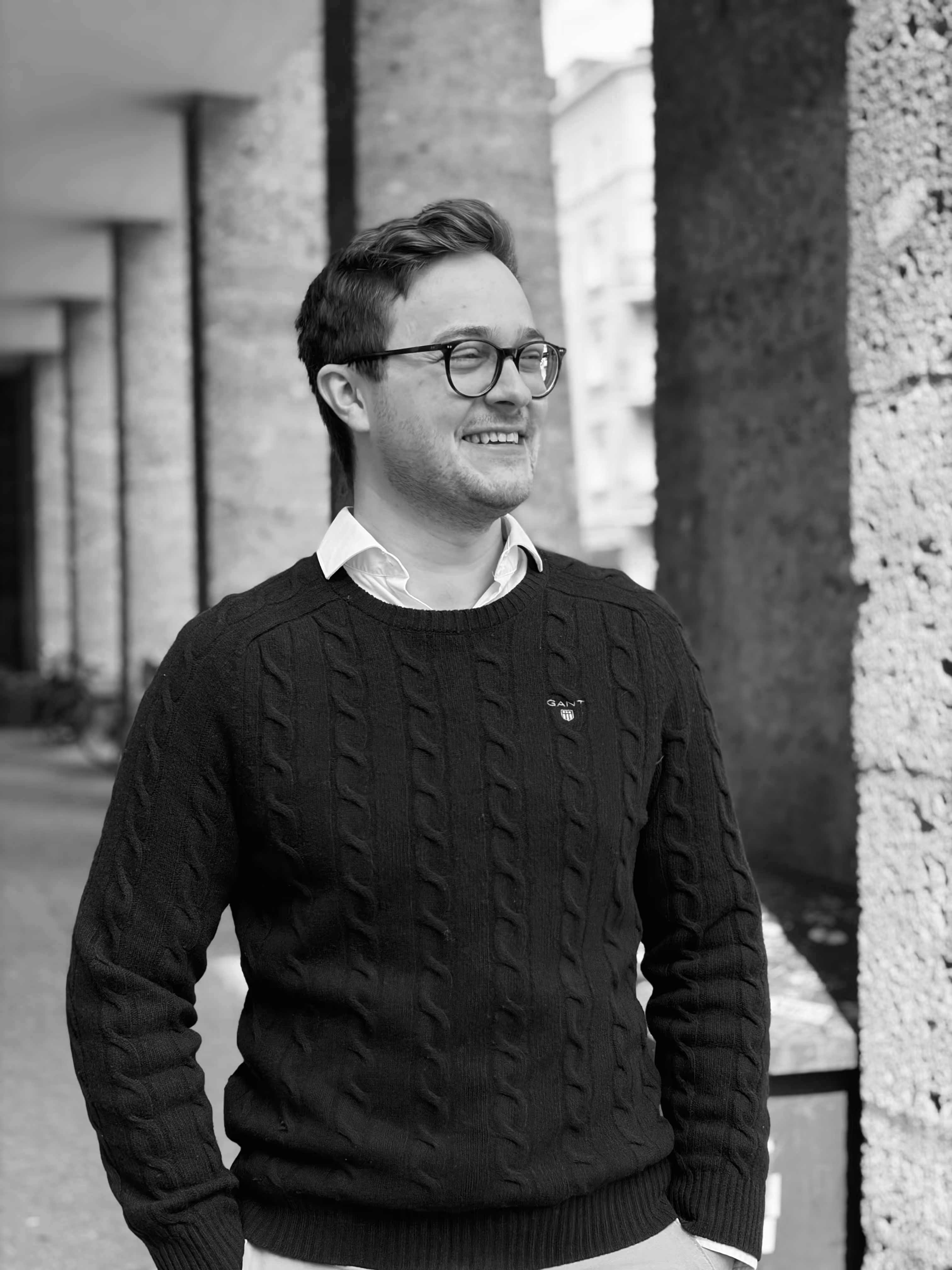
Nicolas Inzelmann
CEO & Founder | Infinitas Security

CISSP-certified cybersecurity consultant with 6+ years of cybersecurity strategy experience.
Explore how AI, scenario thinking and strategic simulations can help cybersecurity teams make future risks more tangible and improve strategic decisions.
Mehr lesen
How strategic foresight can help cybersecurity teams identify weak signals, challenge assumptions and prepare for multiple possible futures.
Mehr lesen
Practical cybersecurity is not just an IT topic for SMEs. It is essential for business continuity, customer trust and growth. This article explains the key challenges small and medium-sized enterprises face when implementing cybersecurity and outlines five principles that help reduce cyber risks in a structured, effective and manageable way.
Mehr lesen
Zero Trust is no longer just a strategic vision for large enterprises. This article explains why its core principles are becoming essential for SMEs, which building blocks matter most, and how companies can start pragmatically without turning Zero Trust into a major transformation project.
Mehr lesen
A practical look at the key cybersecurity "developments" shaping 2026, including AI security, Zero Trust, cyber insurance, OT risk, and evolving EU regulations.
Mehr lesen