



Nicolas Inzelmann
CEO & Founder | Infinitas Security
May 11, 2026



In today’s digitally connected world, small and medium sized enterprises, SMEs, are just as affected by cyber threats as large corporations. However, while large companies can often invest extensive resources in their cyber defense, SMEs face challenges related to limited time, resources and know how.
This article is relevant for:
Finance leaders responsible for security-related costs and budgets
Effective cybersecurity is essential for SMEs to remain competitive and secure in the modern digital economy.
The goal is not to create a large theoretical security program. For most SMEs, the goal is much more practical: understand the most relevant risks, take the right measures in the right order and make sure the company remains able to operate, grow and serve customers.
For executive leadership, effective cybersecurity is far more than just a cost factor. In many SMEs it is still not perceived this way, but it can become a key business enabler.
A structured and proactive approach allows companies to adopt new technologies securely, including cloud services, artificial intelligence, digital collaboration tools, eCommerce platforms, remote work and connected production environments.
By protecting against cyber threats, business leaders can ensure that their company runs smoothly, respond to market changes and seize new business opportunities with more confidence.
Finally, leadership remains accountable for the business and its risks. Operational tasks can be delegated, but the company still needs clear priorities, responsibilities and decisions. Managing cybersecurity risks proactively helps leadership demonstrate due care because risks, measures and decisions are visible instead of improvised.
The direct and indirect costs of a cyberattack can be substantial. These include restoring affected systems and data, external support, legal and contractual consequences, communication efforts and losses caused by operational disruptions.
According to Bitkom’s Economic Protection Study 2025, cyberattacks most recently caused around EUR 202.4 billion in damage to the German economy. 59 percent of companies say that cyberattacks threaten their business existence. A new Bitkom study from 2026 also shows how vulnerable companies are to hybrid threats: in the event of an internet outage, businesses could maintain operations for only 20 hours on average, while 21 percent would have to stop working immediately.
From a financial perspective, effective cybersecurity can reduce avoidable costs by lowering the likelihood of successful attacks and limiting the damage if an incident occurs. Exact savings cannot be generalized across all attack scenarios. They depend on the company, the affected systems, the quality of backups, the speed of response and the level of preparation.
Still, the financial logic is clear: preventive measures are usually more controllable than emergency response. By addressing risks proactively, finance leaders can ensure that budgets are used efficiently for the measures that matter most.
For marketing and sales leaders, cybersecurity plays a crucial role in building and maintaining the company’s reputation. At a time when customers, partners and suppliers place increasing value on data privacy and security, a single security incident can seriously damage trust and brand perception.
Effective cybersecurity not only protects customer data. It also strengthens trust in the brand, which can have a positive impact on customer loyalty, supplier relationships and sales conversations.
The following graphic illustrates the impact of cybersecurity in a sample scenario in which attackers compromise the IT systems of an eCommerce store, copy customer data and demand a ransom payment in exchange for not publishing the data.
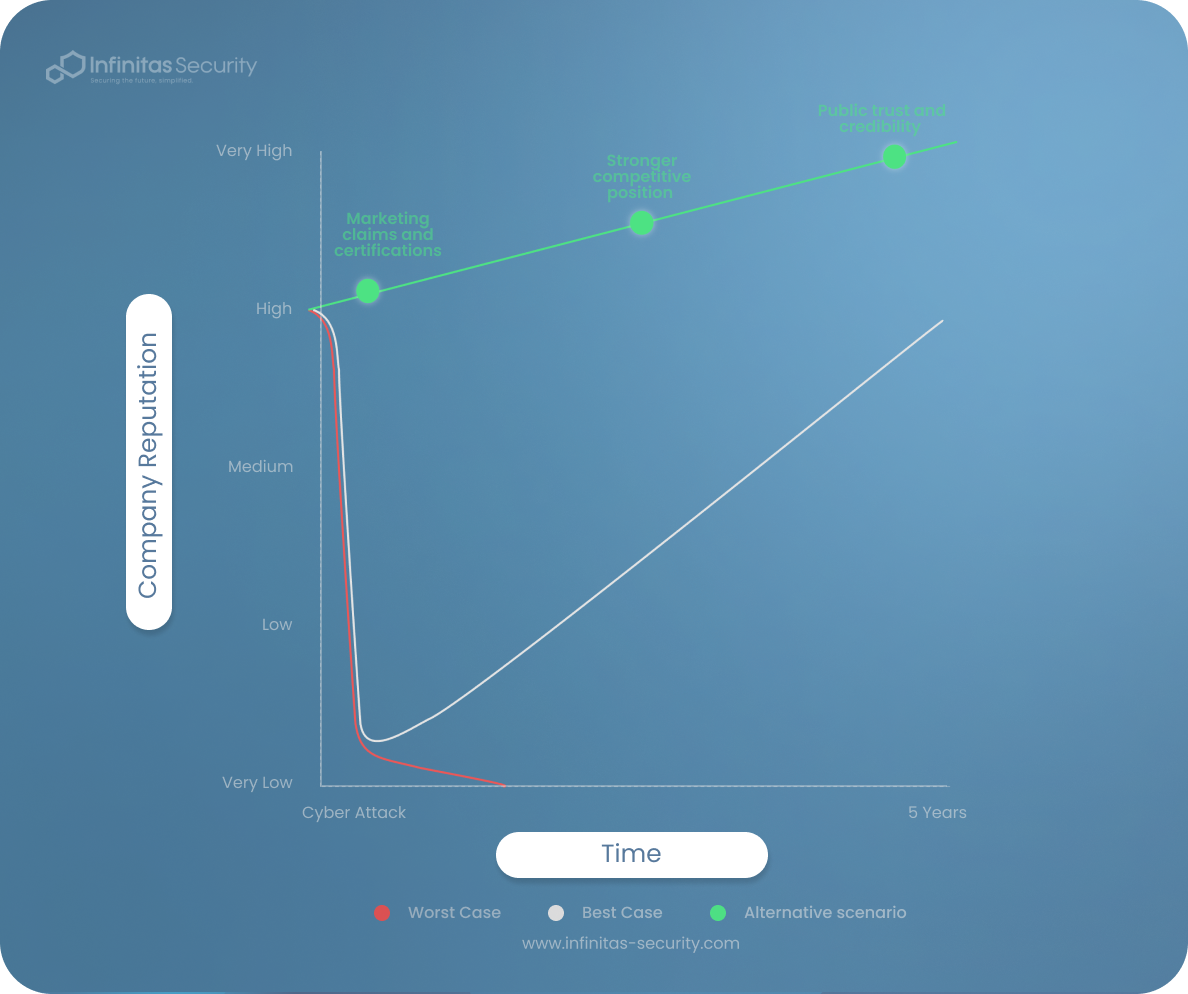
In summary, the illustration shows three potential scenarios:
The exact development will always differ by company and incident type. But the underlying point is important: reputation is difficult to rebuild once customer data has been exposed. Preventing the incident is usually far more valuable than trying to repair trust afterwards.
For operations leaders, maintaining the availability of critical business processes is essential. Cyberattacks can lead to significant disruptions that cause financial losses and can impair the company’s ability to operate effectively in the long term.
Effective cybersecurity identifies and protects critical infrastructure and systems, minimizes downtime and ensures that business processes can continue to run as smoothly as possible, even in the event of an incident.
This includes practical basics such as reliable backups, tested restore processes, secure access rights, patching, secure configurations and clear incident response steps.
By considering all of these perspectives, SMEs can recognize that cybersecurity is not a side topic. It is a business relevant capability that minimizes risks, supports growth and helps companies navigate the digital landscape securely and successfully.
To keep up with the constantly changing threat landscape, SMEs need a structured way to protect the confidentiality, integrity and availability of their assets.
The following elements are especially important:
• Business analysis: assets, data, critical processes, vulnerabilities, threats and dependencies
• Protective measures: processes, technologies and people
• Prioritization: foundations, quick wins and backlog
• Implementation: industry standards, best practices and reusable templates
• Review: simple checks, evidence and improvements over time
At first glance, this may sound like administrative overhead. Especially in SMEs, nobody wants to build a process framework that creates more work than value.
But these activities happen one way or another. Business analysis, planning of measures, implementation and review are either done proactively in a practical format, or they happen reactively during an incident, an audit, a customer request or an insurance discussion.
The question is therefore not whether SMEs need structure. The better question is: to which extent is structure needed, and which practical steps create the most value without overloading the organization?
Turning cybersecurity from a broad requirement into concrete action is where many SMEs encounter the same recurring challenges:
Manual processes still shape cybersecurity work in SMEs and create major inefficiencies that are difficult to manage alongside day to day operations.
Security tasks are often tracked in spreadsheets, evidence is collected manually, policies are updated irregularly and responsibilities are clarified only when something urgent happens.
There is a lack of automation and digitalization to reduce effort and keep cybersecurity close to normal business processes.
Because of the time involved, internal costs for IT specialists or external consultants can be very high and unaffordable for many SMEs.
The challenge is not only the price of tools. It is the total effort required to select, implement, operate and continuously improve them.
There is a lack of cost efficient alternatives that help companies take the right next steps without building an oversized security function.
Due to limited access to expertise, complex and constantly evolving cybersecurity challenges cannot always be solved effectively.
This includes topics such as secure cloud configuration, identity and access management, incident response, supplier security, backup resilience, risk prioritization and regulatory expectations.
The 2025 ISC2 Cybersecurity Workforce Study points to an important shift: cybersecurity professionals increasingly see critical skills as more important than pure headcount, and only 55 percent agree that their organizations have the resources needed to address security incidents in the next two to three years.
There is a lack of easy access to knowledge that already exists in the market and can be applied in a practical way.
The shortage of qualified IT and cybersecurity personnel remains a major challenge. The shortage of qualified IT and cybersecurity personnel remains a major challenge. In Germany, Bitkom reported in August 2025 that around 109,000 IT specialists were missing in the economy. Although this figure is broader than cybersecurity alone, it shows why SMEs often struggle to build large internal expert teams.
SMEs usually compete with large enterprises, consultancies and technology providers for the same talent. This makes it hard to hire, retain and develop specialized security roles internally.
There is a lack of solutions that reduce personnel needs by making cybersecurity easier to structure, delegate, automate and track.
Because communication is often not tailored to leadership, decision makers do not always see a clear cybersecurity related business benefit.
If the discussion focuses only on vulnerabilities, tools or compliance requirements, cybersecurity is easily perceived as a cost center. If it is connected to business outcomes, the discussion becomes more productive.
Relevant outcomes can include reduced downtime risk, faster recovery after incidents, better customer trust, smoother audits, stronger supplier relationships and more efficient use of security budgets.
There is a lack of a communication basis that speaks both the language of experts and the language of management.
Because of the perceived additional work or the assumption that security measures may interfere with business operations, acceptance is sometimes low.
This resistance is understandable when measures are introduced without context, without practical guidance or without considering how people actually work.
The answer is not more rules. The answer is to make secure behavior as simple as possible. Good cybersecurity fits into existing workflows, explains the reason behind measures and gives employees clear steps they can follow.
Among a wide range of solutions with many use cases, there is often too little clarity about which offerings are actually needed.
The cybersecurity market is crowded. There are many tools, providers and services, each promising to solve an important problem. For SMEs, the challenge is understanding what is relevant now and what can wait.
Buying more tools does not automatically create better security. In many cases, SMEs first need clarity about their current risks, existing controls, critical assets and operational gaps.
There is a lack of a way to evaluate offerings easily and in the context of the company’s actual needs.
Implementing effective cybersecurity in small and medium sized enterprises requires an approach that is both pragmatic and structured.
By focusing on five core principles, SMEs can build a solid security foundation that is protective, sustainable and realistic for day to day operations.
A practical cybersecurity approach starts with the most important question: what would really hurt the business if it was unavailable, manipulated or exposed?
SMEs should identify their most critical assets, systems, data and business processes. This allows resources to be concentrated on the areas with the greatest impact.
The goal is not to analyze everything in endless detail. The goal is to create enough clarity to prioritize correctly.
A useful starting point is to define the most relevant risk scenarios for the company, for example ransomware affecting shared drives or production systems, compromised Microsoft 365 accounts, data leakage through misconfigured cloud storage, loss of access to business critical systems or failure of a key IT provider during an incident.
This makes cybersecurity more concrete and helps teams focus on measures that reduce real business risk.
Many SMEs say: “We have outsourced this to our IT provider.”
And in many cases, that is absolutely sensible. A lot of operational work can be handled by external specialists, such as patching systems, operating backups, configuring firewalls, managing endpoint protection, monitoring alerts or supporting the company during incidents.
But outsourcing operational work is not the same as outsourcing responsibility.
The company still needs to know which processes and data are critical, which risks are acceptable, what service levels apply and who makes decisions during an incident. An IT provider can execute many tasks, but it cannot decide what matters most for the business.
The risk is that cybersecurity becomes a black box. Backups may exist but never be tested. Multi factor authentication may not cover all critical accounts. Access rights may no longer reflect actual roles. Incident response may not be included in the provider’s scope.
The practical answer is not to stop outsourcing. It is to keep control inside the company. SMEs should define expectations clearly, request evidence for key measures, review results regularly and make sure business critical decisions remain with the organization itself.
SMEs should not reinvent the wheel. Industry standards, best practices, templates and proven controls can reduce time, cost and uncertainty.
However, standards should be used as guidance, not as paperwork. The purpose is to help the company understand what needs to be done, why it matters and how to move forward step by step.
Practical measures often include multi factor authentication, backup and restore testing, secure configuration, patching, access reviews, endpoint protection, awareness training and a simple incident response process.
The key is to adapt proven practices to the company’s real environment instead of copying a large framework that nobody has time to maintain.
Digitalization and automation allow SMEs to use resources more efficiently and improve their responsiveness to risks.
Many recurring tasks do not need to be managed manually. This includes reminders for security actions, evidence collection, access review documentation, patch tracking, backup test records, risk updates and simple reporting.
Automation does not replace human decision making. It reduces repetitive work so that IT and security responsible people can focus on priorities, exceptions and improvements.
By integrating existing tools and workflows, SMEs can create a more coherent cybersecurity setup that requires less manual intervention and provides better transparency.
Cybersecurity is not finished after a one time implementation. Systems change, employees change, providers change and threats change.
SMEs need a lightweight way to review whether important measures still work. This does not require a large audit program. It can start with practical checks such as testing backup restoration, reviewing privileged access, checking whether critical systems are patched and confirming that incident contacts are up to date.
The same applies to incident readiness. A simple response plan that has been discussed and tested once is much more useful than a perfect document that nobody has ever used.
The goal is continuous improvement without creating unnecessary complexity.
Effective cybersecurity is indispensable for small and medium sized enterprises if they want to remain secure and competitive in today’s digital economy.
For executive leadership, it enables the secure adoption of new technologies and supports digital transformation. From a financial perspective, it helps reduce the direct and indirect costs of cyberattacks by addressing risks proactively. For marketing and sales leaders, protecting customer data is essential to strengthening customer trust and protecting the brand. Operations leaders benefit from maintaining the availability of critical business processes.
At the same time, SMEs face many challenges when implementing cybersecurity in a practical way. These range from manual processes and high costs to a lack of expertise and personnel, as well as unclear provider responsibilities, communication challenges and employee resistance.
Despite these obstacles, the core principles of effective cybersecurity can help SMEs build a robust and sustainable security foundation: focus on what matters most, keep responsibilities clear, use proven standards in a practical way, automate recurring work and review regularly whether the most important measures still work.
These principles allow companies to focus on the areas with the greatest impact, use resources efficiently and maintain a level of security that does not hinder business operations, but enables them.
Cybersecurity should not become a parallel world of documents, tools and abstract plans. It should become part of how the company works.
How does the business benefit from Cybersecurity in SMEs?

Why do SMEs need a structured approach to cybersecurity?
What are the biggest cybersecurity challenges for SMEs?
Can SMEs outsource cybersecurity to their IT provider?
What cybersecurity tasks can be automated?
Share this post

Nicolas Inzelmann
CEO & Founder | Infinitas Security

CISSP-certified cybersecurity consultant with 6+ years of cybersecurity strategy experience.
Practical cybersecurity is not just an IT topic for SMEs. It is essential for business continuity, customer trust and growth. This article explains the key challenges small and medium-sized enterprises face when implementing cybersecurity and outlines five principles that help reduce cyber risks in a structured, effective and manageable way.
Mehr lesen
Zero Trust is no longer just a strategic vision for large enterprises. This article explains why its core principles are becoming essential for SMEs, which building blocks matter most, and how companies can start pragmatically without turning Zero Trust into a major transformation project.
Mehr lesen
A practical look at the key cybersecurity "developments" shaping 2026, including AI security, Zero Trust, cyber insurance, OT risk, and evolving EU regulations.
Mehr lesen