


Artur Bachmann
,
Nicolas Inzelmann
,
September 9, 2026



How three security postures shape cyber insurance, ongoing security management, response and recovery
Infinitas Security GmbH x Dr. Hörtkorn München GmbH
Cyber insurance can provide financial protection and access to specialist support when an incident occurs. But the differences between organizations begin well before an incident.
They appear in how companies understand risk, respond to security requirements, keep information current and deal with changes or identified weaknesses. Those differences continue through incident response, recovery and the question of what happens afterwards.
To understand what this means in practice, we spoke with Artur Bachmann of Dr. Hörtkorn München GmbH about how cyber insurance and security management interact before, during and after a cyber incident.
Artur Bachmann is a cyber insurance specialist and corporate advisor at Dr. Hörtkorn München GmbH. With around 20 years of experience in insurance and more than a decade focused on cyber risk, he advises companies on understanding their exposure and finding appropriate cyber insurance solutions.
Our earlier conversation examined what determines insurability. This time, we take a broader view of what happens around the insurance process itself and how an organization’s approach to cyber security influences its position over time.
The three approaches below are deliberately simplified. They are not universal maturity levels, nor can every company be placed neatly into one of them. Instead, they reflect recurring patterns that Artur has observed from the cyber insurance perspective and Nicolas Inzelmann has encountered over more than six years working in cyber security consulting.
At their core, they describe different organizational attitudes towards cyber risk, insurance and ongoing protection: from reacting when necessary, to becoming ready for insurance at a particular point in time, to treating cyber security as a continuous management responsibility.
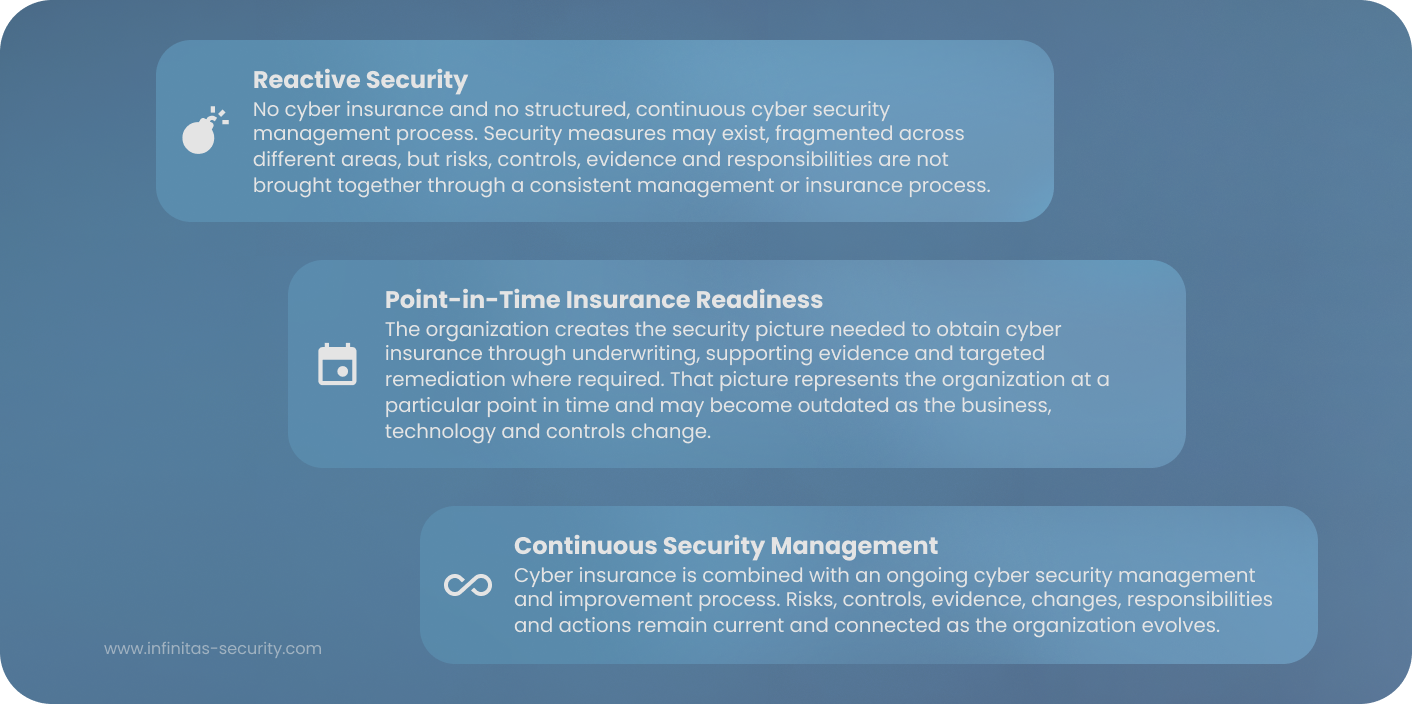
The key difference between Point-in-Time Insurance Readiness and Continuous Security Management is therefore not simply whether security measures exist. It is whether the security position established during underwriting remains primarily a snapshot or becomes part of an ongoing process that keeps it aligned with operational reality.
The four phases below show how these different approaches influence the organization before, during and after a cyber incident.
Before an incident occurs, the first difference is how the organization brings its risk information together, and what happens to that picture once insurance has been obtained.
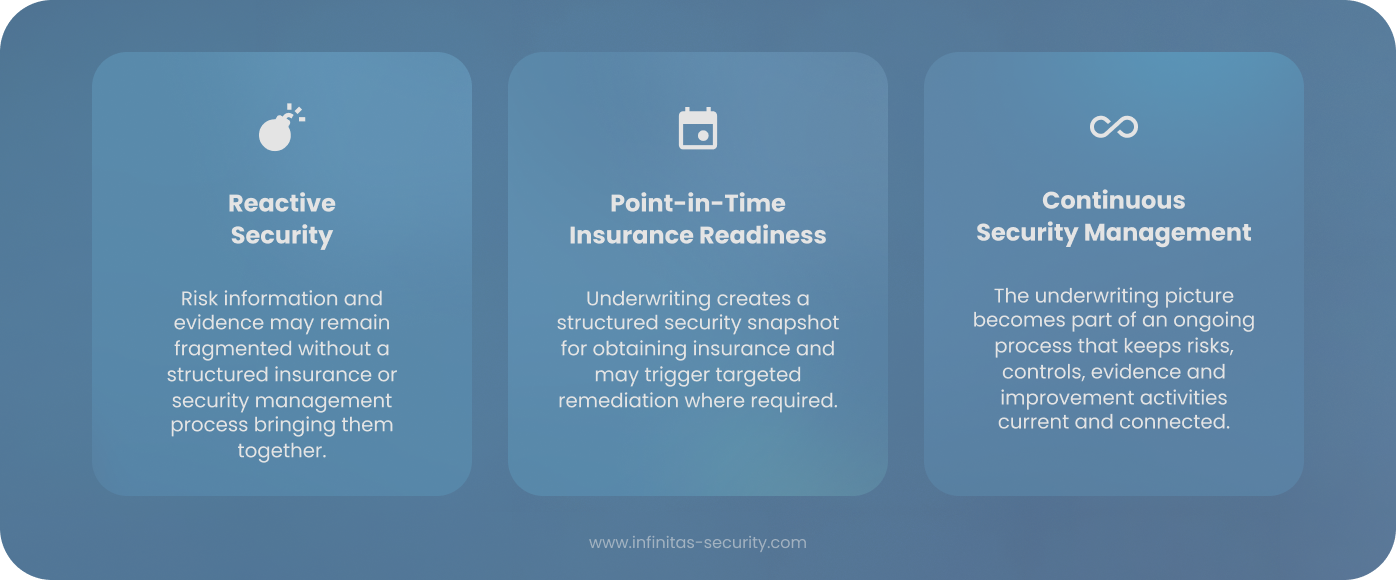
Underwriting can create a first structured view of cyber exposure. Relevant controls need to be understood, gaps discussed and enough information assembled for the insurer to assess the risk.
Artur sees value in that exercise beyond obtaining the policy itself. In his experience, insurer questions are usually there for a reason. They reflect situations that insurers have seen contribute to real losses.
That makes the comparison with Reactive Security particularly relevant. Without insurance or a structured cyber management process, the challenge is often not a complete lack of information. Rather, information about systems, controls, risks and responsibilities may exist in different places without being fully understood and connected into one clear picture.
Point-in-Time Insurance Readiness changes that. The insurance process creates a concrete reason to bring the information together. The organization answers underwriting questions, may provide supporting evidence and may remediate specific gaps that would otherwise stand in the way of obtaining coverage.
The result is valuable, but it remains a snapshot. It reflects the security position presented during underwriting and is only as reliable as the information available and the way individual questions are understood. Even where that picture is accurate at placement, it does not automatically remain accurate as systems, suppliers, responsibilities and controls change.
Continuous Security Management uses the same underwriting exercise as a starting point rather than an endpoint. Risks, controls, findings and improvement measures remain connected after placement, so the picture created for insurance continues to evolve with the organization.
The value of the insurance assessment should not end when the policy is signed.
A similar distinction appears in evidence readiness.
For Point-in-Time Insurance Readiness, the underwriting process creates a reason to collect documents, confirm controls and provide evidence where required. That alone can create useful structure and reveal gaps that might otherwise have remained unnoticed.
But collecting evidence for placement is different from keeping it current afterwards. Without an ongoing management process, documents can become outdated, responsibilities can change and the information assembled during underwriting can gradually move away from operational reality.
With Continuous Security Management, evidence is maintained as part of the normal security process. It can therefore support not only insurance discussions, but also ongoing risk management, remediation and future underwriting without having to reconstruct the underlying picture each time.
Under Reactive Security, relevant documents and security measures may still exist. The difference is that there is no equivalent process consistently bringing them together, validating their relevance and connecting them to a wider risk picture.
This is also where underwriting can create value beyond coverage.
A weakness identified during the insurance process does not have to remain an answer in a questionnaire. Under Point-in-Time Insurance Readiness, it may trigger the specific remediation needed to obtain insurance. Under Continuous Security Management, the same finding can become part of a broader security roadmap, remain visible after placement and continue to influence priorities as the organization changes.
Artur has seen measures agreed with insurers remain open for two or three years.
It is a simple example, but it illustrates a broader challenge: once the policy is in place, the organization continues to change, while the security picture created during underwriting can quickly become outdated.
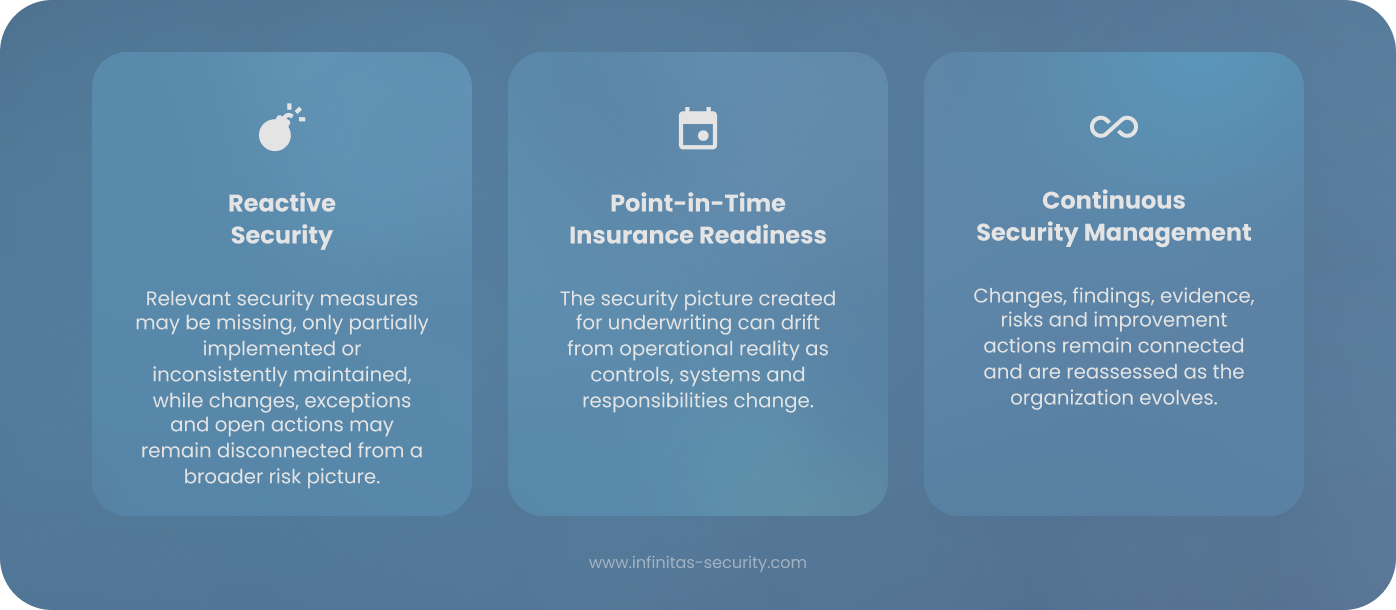
Point-in-Time Insurance Readiness creates a structured security picture for obtaining insurance. Specific controls may have been demonstrated, gaps remediated and statements made about how the organization is secured at that moment.
The challenge begins after placement.
A control can change. An agreed measure can remain unfinished. An exception can become permanent. A supplier can be replaced, responsibilities can move and systems can be introduced or retired. Even an accurate underwriting picture can therefore gradually move away from operational reality.
This does not mean that security activity stops once the policy is signed. The issue is that, without a structured ongoing management process, there may be no consistent mechanism ensuring that relevant changes are reassessed and reflected in the risks, controls, evidence and representations on which the original insurance assessment was based.
A future renewal or insurer request may bring some of those developments back into focus. But by then, the gap may have existed for months, and some changes may only become visible when information has to be assembled again.
Continuous Security Management addresses that gap by keeping changes connected to the wider security picture as they occur. Open actions, control changes, exceptions, evidence and responsibilities remain visible and can be reassessed before they become part of a significantly different operating reality.
Meeting the requirement once is different from keeping it effective over time.
The same principle applies beyond individual controls. Businesses change continuously through new technologies, suppliers, responsibilities, processes and dependencies. Each change may appear manageable on its own; the difficulty is recognizing when several of them materially alter the wider cyber risk.
Under Point-in-Time Insurance Readiness, the picture created during underwriting may remain the main structured reference until the organization is asked to revisit it. That snapshot still has value, but its usefulness decreases as the organization moves further away from the conditions under which it was created.
With Continuous Security Management, relevant developments feed back into risks, controls, evidence and responsibilities while they are still current. The purpose is not to reassess everything constantly, but to ensure that material changes can influence the security picture and trigger action when needed.
Artur’s broader point is that insurability cannot simply be assumed to continue because a company qualified for insurance once. The organization and its risk continue to evolve.
Under Reactive Security, changes may of course still be addressed individually. What is missing in this comparison is both the insurance-based starting point and a structured management process that keeps those developments connected to a broader risk picture.
The issue is therefore not simply how often information is collected. It is whether the organization has a mechanism for recognizing when reality has changed enough that its risks, controls or previous assumptions need to change with it.
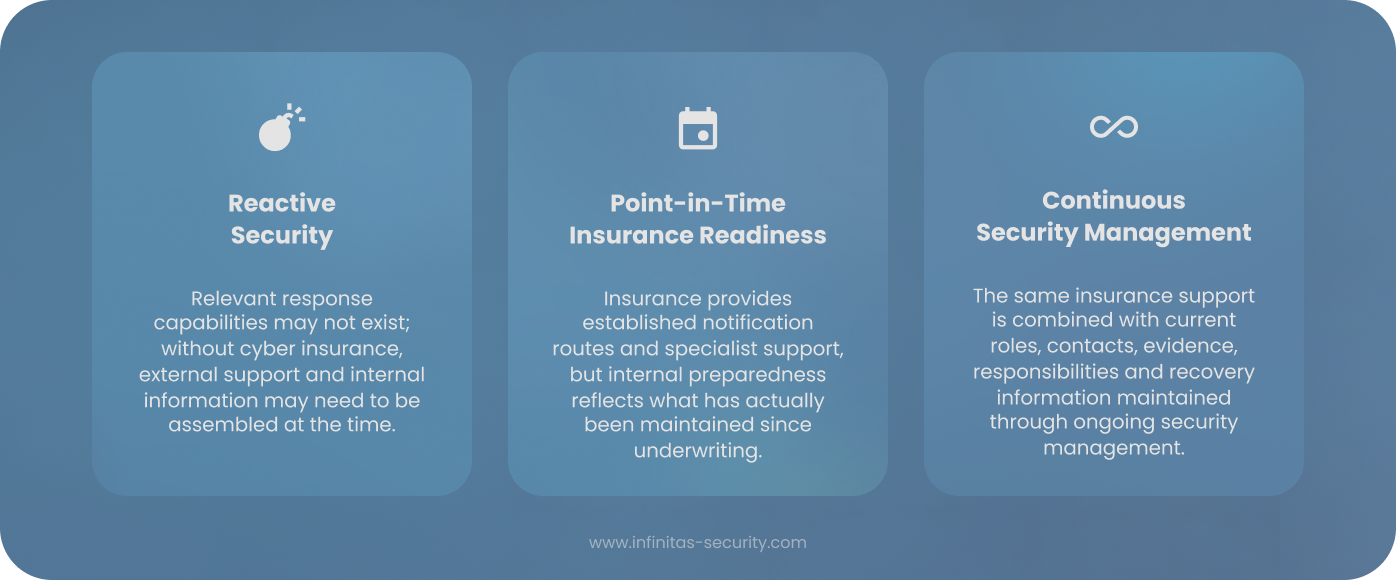
Once an incident occurs, the practical consequences of how the organization prepared beforehand become much clearer. Insurance determines which external support can be activated, while the organization’s actual preparedness determines how effectively that support can be used.
There is another difference before the response even begins. Continuous Security Management can reduce the likelihood that unresolved weaknesses, control drift or unmanaged changes contribute to a material incident in the first place. It cannot eliminate cyber incidents, which is why response and recovery capabilities remain essential. This is where Artur sees preparation having one of its most tangible effects.
“Cyber claims are handled much better, and much more cheaply, when a company has proper business continuity management in place.”
Cyber insurance can give an organization access to forensic, legal and other specialist support. For Point-in-Time Insurance Readiness, that already creates an important advantage over having to organize the response ecosystem from scratch. Established notification routes provide a clear way to activate the support available through the policy.
But getting insured does not automatically mean that the organization is operationally prepared for the incident that eventually occurs.
The security picture created during underwriting is a snapshot. It may have been accurate at placement, may have contained incomplete or differently understood information, or may simply no longer reflect the organization after systems, suppliers, responsibilities and controls have changed.
External specialists therefore still need current internal knowledge. They need the right people, an understanding of the affected environment, clarity about critical processes and reliable information on responsibilities and recovery options.
This is where Continuous Security Management changes the starting position. The insurance response structure is the same, but information about systems, risks, contacts, responsibilities and recovery arrangements is kept connected to the organization as it evolves. The objective is not to create a different insurance response, but to make sure the internal picture available when that response is activated is closer to current reality.
Under Reactive Security, relevant expertise, response plans or established providers may also exist. But there is no cyber insurance structure to rely on in this comparison, and where those capabilities have not been prepared beforehand, the organization may need to identify external support while simultaneously assembling the internal information required for decisions.
Insurance can bring specialists into the response. Internal preparedness determines how effectively the organization can work with them.
Artur’s point about Business Continuity Management moves the discussion beyond cybersecurity controls alone.
An incident requires more than technical containment. The organization also needs clear decisions, communication, current contacts and a practical way for critical operations to continue or recover.
Under Point-in-Time Insurance Readiness, some of those structures may have existed or been considered when the organization obtained insurance. But the underwriting process does not by itself ensure that they remain usable afterwards. Contacts change. Responsibilities move. Systems and dependencies evolve. Supporting providers can be replaced.
A BCM plan that was valid at placement can therefore lose practical value if it is not maintained.
Continuous Security Management connects this preparedness to the ongoing management process. Changes to responsibilities, dependencies, providers or recovery arrangements can be reflected as the organization changes, reducing the gap between documented preparedness and the environment that actually exists when an incident occurs.
For Artur, this is why maintaining Business Continuity Management matters just as much as having it. He does not describe BCM as a universal requirement for cyber insurance. Its value becomes particularly visible when the organization actually needs to respond and recover.
The distinction is therefore not that insurance creates preparedness on its own. Insurance provides access to a response structure and specialist support. The organization still needs current knowledge, responsibilities and recovery capabilities to make that support effective.
Once the immediate response is under control, the focus shifts to the financial impact, what the claim reveals about the organization’s actual security position, and what changes afterwards.
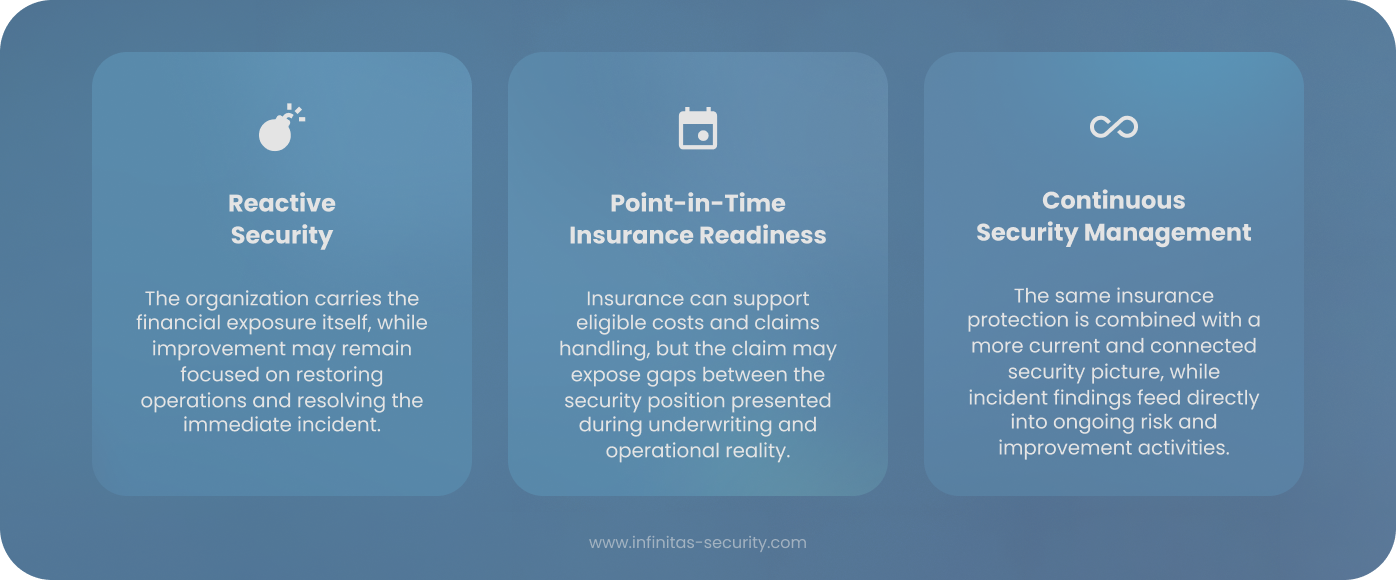
Under Reactive Security, there is no cyber insurance in this simplified comparison. The company carries the relevant costs itself and manages recovery using the resources and providers available to it.
Insurance changes that equation for both Point-in-Time Insurance Readiness and Continuous Security Management. Eligible costs can be covered according to the policy, while the broker, insurer and specialist providers can support the claims and recovery process.
It is important, however, not to overstate the difference between the two insured approaches. Continuous Security Management does not necessarily mean broader insurance protection. The policy terms may be exactly the same.
What changes is the security position from which the organization enters the claim.
With Point-in-Time Insurance Readiness, the organization presented a particular picture of its security during underwriting in order to obtain coverage. That picture may have been accurate at the time, but individual questions can also be misunderstood or answered on the basis of incomplete information. More importantly, even an accurate initial picture can become outdated as systems, suppliers, responsibilities, controls and exceptions change.
This can become relevant during a claim. If the security position at the time of the incident differs materially from policy-relevant declarations or requirements, and that difference is relevant to the incident, it may need to be examined as part of claims handling and, depending on the policy and circumstances, can potentially affect coverage.
The issue is therefore not simply whether the organization was able to obtain insurance. It is whether the assumptions and representations on which that insurance was based still reflect operational reality when they matter.
Continuous Security Management does not remove this obligation or guarantee a particular claims outcome. It creates a stronger basis for keeping changes, controls, evidence, exceptions and responsibilities connected as the organization evolves. This can make material deviations visible earlier and reduce the need to reconstruct the organization’s security position while it is already dealing with an incident.
Artur pointed to backup recovery as a useful example.
The important question is not simply whether backups were described as being in place. What matters during an incident is whether the organization can actually restore the systems and information it needs.
A claim therefore tests more than the security picture presented during underwriting. It reveals how controls perform under real conditions.
For Point-in-Time Insurance Readiness, this can expose a difference between what the organization believed, documented or represented during underwriting and what actually works during recovery. If that difference is relevant to the incident, it may need to be explained during the claim. Regardless of the claims outcome, it can also create a clear need for remediation and become relevant to future underwriting.
With Continuous Security Management, controls and changes are reassessed as part of the ongoing security process rather than only when insurance information has to be assembled. This does not mean that every weakness will be identified before an incident, but it creates a clearer mechanism for detecting deviations, recording exceptions and keeping the organization’s security picture closer to current reality.
When recovery reveals that a control did not perform as expected, the finding can then be connected directly to the relevant risk, owner and improvement activity.
An incident creates information that no questionnaire can fully reproduce.
It shows where decisions became difficult. Which controls worked. Which did not. Where recovery was slower than expected. Where responsibilities were unclear. It can also show where the security position assumed during underwriting no longer matched operational reality.
Under Point-in-Time Insurance Readiness, those findings can trigger remediation after the incident and become relevant to future underwriting. The insurer may want to understand what happened, whether previous assumptions or declarations still applied and what the organization has changed in response.
Continuous Security Management connects the same findings directly with the ongoing security process. They can become updated risks, actions, priorities and responsibilities, while changes to controls and evidence remain part of the organization’s current security picture rather than being addressed only for the next insurance interaction.
Under Reactive Security, lessons may also lead to significant improvements. The difference in this comparison is that there is no structured insurance process or continuous security management mechanism ensuring that those lessons remain connected to a broader risk and improvement process.
After a claim, the important question is not only what went wrong, but what the organization changed because of it.
That distinction also matters for future insurability.
Artur’s experience is that a company does not need to pretend it has no weaknesses. What matters is whether it understands them and can show that meaningful improvements are being made.
Recovery therefore does more than return the organization to normal operations. It creates a new understanding of the risk.
The important question is whether that understanding remains connected to what the organization does next.
The three approaches highlight a simple but important distinction.
Cyber insurance and cyber security management do not solve the same problem.
Insurance can transfer part of the financial exposure, create a structured underwriting process and provide access to specialist support when an incident occurs.
In this simplified comparison, Reactive Security lacks both that insurance structure and a continuous security management process. Point-in-Time Insurance Readiness changes the position significantly: the organization creates the security picture required for underwriting, may remediate specific gaps and gains the financial protection and response support provided by the policy.
Continuous Security Management does not replace those benefits. It builds on them.
The main difference is continuity.
Instead of allowing the security picture created during underwriting to remain a snapshot, the organization keeps risks, controls, evidence, changes, exceptions and responsibilities connected as the business evolves. The objective is to keep the picture used for insurance closer to the reality that exists when it is eventually needed.
That is why the difference between Point-in-Time Insurance Readiness and Continuous Security Management may be difficult to see on the day the policy is signed. At that moment, both organizations may appear similarly prepared.
The difference becomes visible later: when systems or suppliers change, when a control no longer works as expected, when evidence is needed, when an incident tests previous assumptions, when a claim has to be assessed against current reality, and when lessons from recovery need to become concrete improvements.
An incident can happen under any of these approaches. Insurance changes the financial protection and specialist support available when it does. Continuous security management changes how closely the organization’s security picture still reflects the reality it is actually facing.
Read more about what makes a company insurable and why maintaining that position requires more than passing the initial insurance assessment HERE.
What is the difference between Point-in-Time Insurance Readiness and Continuous Security Management?

Does cyber insurance automatically mean an organization is prepared for a cyber incident?
Why is continuous security management relevant before and after a cyber incident?
Share this post


Artur Bachmann
Cyber Insurance Specialist & Corporate Advisor | Dr. Hörtkorn München
Artur Bachmann is a cyber insurance specialist and corporate advisor at Dr. Hörtkorn München GmbH, with around 20 years of insurance experience and more than a decade focused on cyber risk and cyber insurance.

Nicolas Inzelmann
CEO & Founder | Infinitas Security

CISSP-certified cybersecurity consultant with 6+ years of cybersecurity strategy experience.
Compare three security approaches before, during and after a cyber incident, and see how insurance readiness shapes response, recovery and improvement.
Mehr lesen
Cyber insurance can look deceptively simple from the outside. A company completes a questionnaire, and the insurer uses those answers to assess the risk. But behind those checkboxes, two companies can have very different risk quality. To understand how that works in practice, we spoke with Artur Bachmann of Dr. Hörtkorn München GmbH about how cyber insurers assess companies, which controls can determine insurability and how underwriting can create value beyond the policy itself.
Mehr lesen